
7 In-Demand Digital Skills in Luxembourg for 2026 Careers
Sitting in a quiet library in Kirchberg, you can see the future of work without needing a conference badge. A student is editing a CV. Someone else has a spreadsheet open next to a job platform. A professional is switching between emails, a dashboard and what looks like an AI assistant. Around them, books are still doing what books have always done: slowing people down just enough to think properly.
That contrast feels very Luxembourg. The country is small, but the work happening around it is not. Finance, public administration, European institutions, cybersecurity, startups, research, space, digital public services and AI all meet here in a surprisingly compact space. For anyone trying to build a career, change direction or simply stop feeling behind, one question matters more than ever: which digital skills are actually worth learning now?
The answer is not “learn everything.” That is how people burn out before they begin. The smarter answer is to focus on digital skills in Luxembourg that connect to real market needs, public initiatives and daily workplace demand.
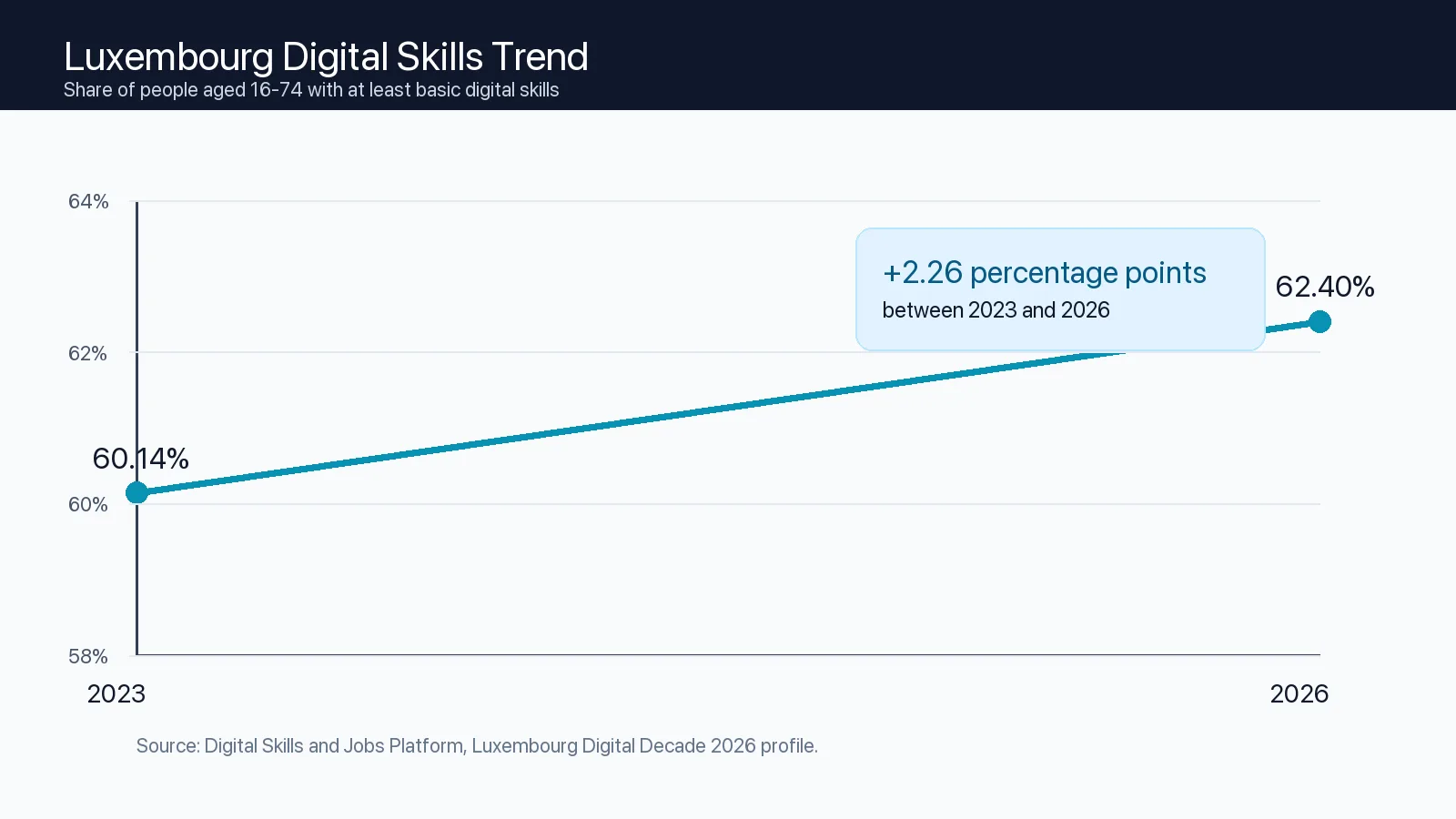
According to the Digital Skills and Jobs Platform, Luxembourg reached 62.40% of individuals aged 16-74 with at least basic digital skills in the 2026 Digital Decade profile, up from 60.14% in 2023. That is progress, but it also shows there is still room for growth. The gap is not only technical. It is practical: knowing how to use tools, understand data, work safely, communicate clearly and prove your value in a digital environment. In that sense, digital skills in Luxembourg are becoming a career foundation, not a bonus.
Executive Data Summary: 2026 Luxembourg Digital Skills Matrix :
| Digital Skill | High-Demand Sectors in Luxembourg | Essential Tools / Frameworks | Core Value Proposition |
|---|---|---|---|
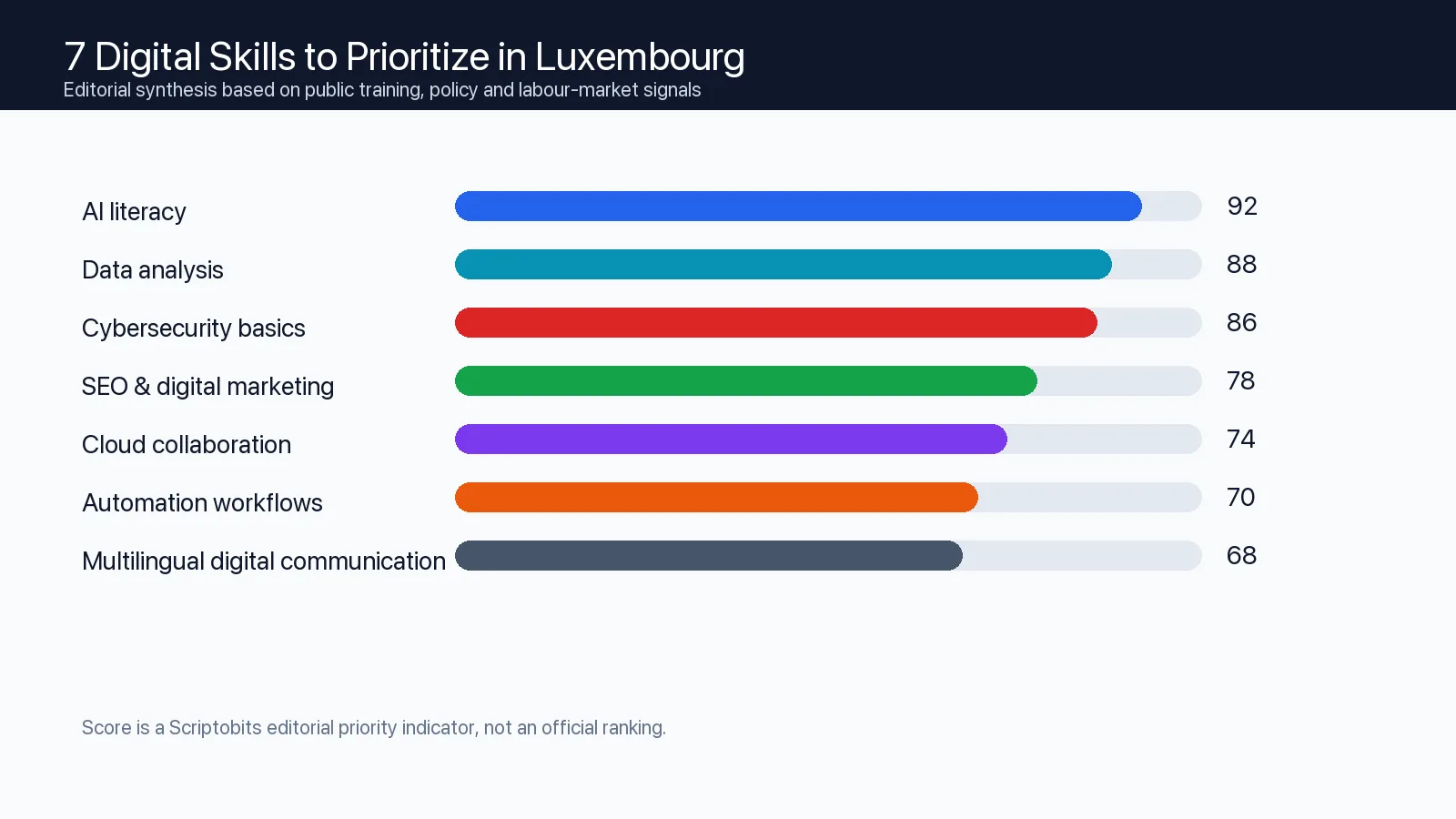
| 1. AI Literacy | Finance, Public Admin, Research | ChatGPT, Claude, Copilot | Data privacy compliance, workflow acceleration |
| 2. Data Analysis | Logistics, Consulting, Startups | Excel, Google Sheets, SQL | Turning raw HR/Sales data into clear reporting |
| 3. Cybersecurity | Banking, European Institutions | Password Managers, MFA | Phishing prevention, GDPR compliance |
| 4. Multilingual SEO | Local Services, E-commerce | Google Search Console | Multilingual visibility (EN, FR, DE, LU) |
| 5. Cloud Collaboration | Cross-border Hybrid Teams | MS 365, Notion, Slack | Version control, cross-border workflow |
| 6. Automation | SMEs, Administrative, HR | Zapier, Make, No-code | Eliminating repetitive manual reporting |
| 7. Digital Comms | All Sectors (B2B & B2C) | AI Translators, LinkedIn | Adapting technical tone across 4 languages |
Data context: Based on 2026 market demands and the Luxembourg Digital Skills baseline of 62.40%.
This guide looks at seven in-demand digital skills in Luxembourg for 2026. It is written for students, job seekers, career switchers, freelancers, employees and curious professionals who want a realistic path forward. The goal is simple: make digital skills in Luxembourg feel practical, local and achievable.
Why Digital Skills in Luxembourg Matter in 2026
Luxembourg has been investing in digital transformation for years, but 2026 feels especially important. The Digital Learning Hub announced three specialized academies for 2026 focused on Data and AI, Cybersecurity and Quantum computing. The government has also supported research and development projects linked to data, artificial intelligence and quantum technologies, with the goal of reinforcing digital sovereignty and competitiveness. These priorities make digital skills in Luxembourg more valuable across both technical and non-technical roles.
That may sound far away from everyday careers, but it is not. When a country invests in AI, cybersecurity, data and advanced technologies, the labour market slowly changes around those priorities. Companies need people who can understand tools, manage information, protect systems, communicate with clients, improve workflows and adapt quickly. That is why digital skills in Luxembourg now matter for almost every ambitious professional.
ADEM’s 2026 shortage occupations list also reminds us that employers are still struggling to find the right profiles in key areas. Not every shortage is digital, of course, but the broader message is clear: employability is increasingly about matching your skills to real demand.
The good news is that you do not need to become a senior engineer to benefit from digital upskilling. Many of the most useful skills sit between technology and everyday work. They help you become better at your current job, more credible in interviews and more confident when tools change again. In other words, digital skills in Luxembourg are useful because they improve real work, not just CV keywords.
1. AI Literacy
AI literacy is the first skill to take seriously, but not in the shallow sense of “knowing how to ask ChatGPT a question.” Real AI literacy means understanding how to use AI tools responsibly, how to evaluate their outputs, how to protect sensitive information and how to turn AI into better work instead of louder noise.
In Luxembourg, this matters because AI is becoming connected to sectors where trust is essential: finance, administration, research, cybersecurity, healthcare and professional services. A careless AI workflow can create privacy risks, poor decisions or polished nonsense. A careful one can save time, improve research, support writing, summarize documents, test ideas and help teams move faster. This is why AI literacy now belongs inside any serious plan for digital skills in Luxembourg.
For a job seeker, AI literacy can improve your CV, interview preparation, portfolio projects and daily learning. For an employee, it can help with meeting notes, document summaries, email drafts, research briefs and repetitive tasks. For a freelancer or entrepreneur, it can support content creation, customer research, product descriptions and planning.
The key is not to let the tool replace your thinking. Use AI as a draft partner, research assistant or second pair of eyes. Then verify, edit and add judgment. Used this way, AI becomes one of the most adaptable digital skills in Luxembourg.
Practical first steps:
- Learn prompting basics with clear goals, context and constraints.
- Compare AI answers against official sources before trusting them.
- Build one small workflow, such as turning meeting notes into action items.
- Keep private client, employer and personal data out of public AI tools unless your organization has approved the workflow.
2. Data Analysis
Data analysis is one of the most useful digital skills in Luxembourg because nearly every organization has data, but not every organization understands it well. A company may have sales data, HR data, customer feedback, website analytics, financial reports or operational dashboards. The problem is often not the lack of information. It is the lack of clarity.
You do not need to start with advanced machine learning. Start with spreadsheets, clean tables, charts and simple explanations. If you can take messy information and turn it into a clear insight, you already become more valuable. For many roles, this is one of the most practical digital skills in Luxembourg to demonstrate quickly.
This skill is especially useful in Luxembourg because many jobs sit inside structured, regulated or international environments. Clear reporting matters. So does accuracy. A person who can explain a trend without exaggerating it is useful in finance, public administration, marketing, logistics, consulting, operations and startups.
A good data skill stack for 2026 might include Excel or Google Sheets, basic dashboard thinking, data cleaning, chart reading and beginner SQL or Python if you want to go further. Among digital skills in Luxembourg, data analysis is also one of the easiest to prove with a small portfolio project.
What to practise:
- Clean a messy spreadsheet and document every change.
- Build a simple dashboard with three useful metrics.
- Learn the difference between correlation and causation.
- Explain one chart in plain English or French without hiding behind jargon.
3. Cybersecurity Basics
Cybersecurity is no longer only for specialists. Everyone who works with email, cloud files, passwords, client data or online payments needs basic cyber hygiene. In Luxembourg, this is even more important because trust is a national economic strength. Finance, public institutions, professional services and regulated sectors cannot afford casual security habits.
The Luxembourg House of Cybersecurity and national digital initiatives show how seriously the country treats cyber resilience. But resilience does not start only with experts in security operations centres. It starts with people making better daily decisions.
Basic cybersecurity skills include password management, multi-factor authentication, phishing awareness, safe file sharing, device updates, privacy settings and knowing when to report something suspicious. These sound simple, but they are often the difference between a normal workday and a serious incident. For employers, these digital skills in Luxembourg show maturity and care with information.
For career growth, cybersecurity awareness is a useful differentiator. Even if you are applying for a marketing, admin, HR, finance or customer support role, showing that you understand data protection and secure work habits makes you look more professional. It also proves that digital skills in Luxembourg are not only about advanced tools, but also about responsible everyday practice.
Start here:
- Use a password manager and unique passwords.
- Turn on multi-factor authentication for important accounts.
- Learn how phishing emails manipulate urgency and fear.
- Understand basic GDPR and data protection principles.
- Practise explaining cyber risk in simple language.
4. SEO and Digital Marketing
SEO and digital marketing remain highly practical skills, especially for freelancers, small businesses, creators, local services and international companies operating from Luxembourg. A business can have a good offer and still be invisible online. That is where digital marketing becomes more than promotion. It becomes infrastructure.
Scriptobits already has an article on digital marketing and SEO in Luxembourg, so this section does not need to repeat that guide. The career point is simple: knowing how search, content, analytics and user intent work can help you in many roles, not only marketing jobs.
If you understand SEO, you understand how people search for answers. If you understand analytics, you understand whether content is actually working. If you understand content strategy, you can help a company explain itself clearly. These digital skills in Luxembourg are especially powerful for small businesses that need visibility without wasting budget.
In Luxembourg, multilingual SEO is especially interesting. People search in English, French, German and sometimes Luxembourgish. A page that works in one language may miss another audience entirely. That makes digital marketing here more complex, but also more valuable. For local businesses, digital skills in Luxembourg often mean understanding both search behaviour and language context.
Skills to learn:
- Keyword research and search intent.
- On-page SEO basics: title, headings, meta description, internal links.
- Google Search Console and analytics basics.
- Local SEO for Luxembourg businesses.
- Content planning for multilingual audiences.
5. Cloud Collaboration
Cloud collaboration sounds basic until you work in a team where files are duplicated, links are broken, permissions are chaotic and nobody knows which version is final. In hybrid and international workplaces, this skill matters every day.
Luxembourg’s workforce is multilingual and cross-border. Teams often include residents, frontaliers, expats, consultants and partners in other countries. That makes digital collaboration essential. Knowing how to organize shared folders, manage permissions, document decisions and keep projects readable is a real professional skill.
Cloud collaboration includes tools like Microsoft 365, Google Workspace, Notion, Slack, Teams, shared calendars, project boards and collaborative documents. But the tool is not the skill. The skill is making work easier for other people.
Someone with strong cloud collaboration habits reduces confusion. They name files clearly, write useful notes, respect access rights and make information findable. That may not sound glamorous, but teams notice it quickly. In hybrid teams, digital skills in Luxembourg often begin with making shared work easier for everyone.
Practise this:
- Create a clean folder structure for one project.
- Write a one-page project brief.
- Use comments and tracked changes properly.
- Learn basic permission settings.
- Keep meeting notes short, searchable and action-oriented.
6. Automation Workflows
Automation is one of the most underrated career skills because it sits between technical and non-technical work. You do not always need to code to automate. Many useful workflows can be built with no-code tools, spreadsheet formulas, templates, email rules, AI assistants or simple integrations.
The goal is not to automate people out of the picture. The goal is to remove boring repetition so people can focus on judgment, communication and better decisions.
In Luxembourg, automation can help small businesses, administrative teams, consultants, creators and startups save time. Imagine automatically collecting form responses, organizing leads, creating weekly reports, sending reminders or turning raw notes into structured tasks.
A good automation mindset starts with one question: what do I repeat every week that could become a checklist, template or workflow? This is one reason automation belongs on any list of digital skills in Luxembourg for 2026.
Begin with small automations:
- Turn repeated emails into templates.
- Use forms to collect structured information.
- Build a weekly reporting template.
- Connect a spreadsheet to a task list.
- Document the workflow so someone else can understand it.
7. Multilingual Digital Communication
Luxembourg has one digital skill that many larger markets underestimate: multilingual communication. Technical knowledge becomes much more powerful when you can explain it across languages, cultures and professional backgrounds.
This does not mean you must be perfect in every language. It means you should be able to adapt your message. A LinkedIn post, client email, internal report, tutorial, support reply and project proposal all require different levels of detail.
In a Luxembourg career context, this skill is especially useful because teams may switch between English and French, while administrative, local or client contexts may require German or Luxembourgish. Clear communication reduces friction.
AI can help with translation and drafting, but it cannot replace local sensitivity. You still need to check tone, accuracy and context. A literal translation may be correct and still feel wrong.
Ways to improve:
- Rewrite one technical idea for three audiences: beginner, manager and specialist.
- Practise short professional emails in English and French.
- Build a bilingual LinkedIn profile or portfolio summary.
- Learn how to summarize complex topics without losing accuracy.
- Ask native speakers or colleagues for feedback when tone matters.
A 12-Week Roadmap for Digital Skills in Luxembourg
The biggest mistake people make with digital skills is trying to learn everything at once. A better strategy is to build proof in small phases. Employers and clients do not only want to hear that you are motivated. They want evidence. A focused roadmap for digital skills in Luxembourg makes that progress easier to see.
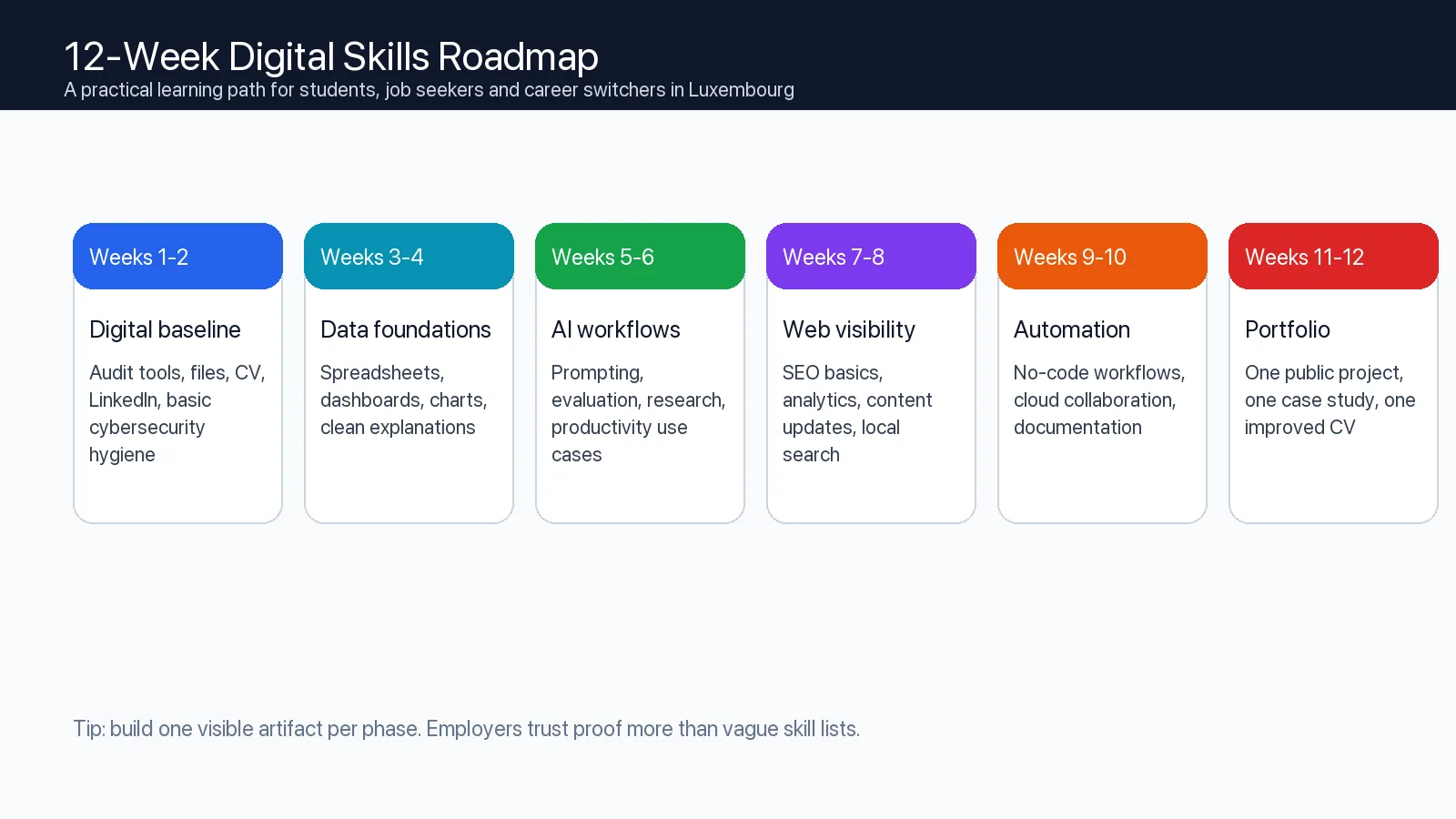
Weeks 1-2 can focus on your digital baseline: update your CV, clean your LinkedIn profile, organize files, secure accounts and identify the roles you want.
Weeks 3-4 can focus on data: build a small spreadsheet dashboard and practise explaining the result.
Weeks 5-6 can focus on AI workflows: use AI to support research, writing, planning or interview preparation, but keep a verification habit.
Weeks 7-8 can focus on web visibility: learn basic SEO, analytics and content structure.
Weeks 9-10 can focus on automation: create one workflow that saves time every week.
Weeks 11-12 can focus on your portfolio: publish one case study, one small project or one before-and-after example that proves what you can do.
The result does not need to be perfect. It needs to be visible, because digital skills in Luxembourg become more valuable when people can see what you built.
How to Turn These Skills Into Career Value
Learning is useful, but proof is better. If you want these digital skills in Luxembourg to help your career, turn them into visible outcomes.
Instead of writing “AI skills” on your CV, explain how you used AI to improve a research workflow while checking sources. Instead of writing “data analysis,” show a dashboard you built. Instead of writing “SEO,” show a page you optimized and what changed. Instead of writing “cybersecurity awareness,” mention specific habits such as MFA, access control and phishing prevention.
For students, this could become a portfolio. For job seekers, it could become stronger interview material. For employees, it could become a proposal to improve a process at work. For freelancers, it could become a service package.
The best skill is the one you can demonstrate. That is why digital skills in Luxembourg should always be connected to examples, projects and measurable improvements.
Final Thoughts
Luxembourg’s digital future is not only being built by engineers, researchers or startup founders. It is also being built by ordinary professionals who decide to become more fluent with the tools shaping their work.
That is why digital skills in Luxembourg matter in 2026. The country is investing in AI, data, cybersecurity and advanced technologies, but the real transformation happens when people learn how to use those tools with judgment.
From a library table in Kirchberg, the lesson feels simple. You do not need to master the entire digital world this year. You need to choose a few skills that make you more useful, more adaptable and more confident. Start with digital skills in Luxembourg that match real jobs, real tools and real proof.
Start with AI literacy. Add data analysis. Protect your work with cybersecurity basics. Learn SEO if visibility matters. Organize your cloud collaboration. Automate one repeated task. Communicate clearly across languages.
That is already a serious foundation for digital skills in Luxembourg.
And if you build proof as you learn, 2026 can become more than another year of watching technology change from a distance. It can become the year you start using it to move your career forward.
FAQ
What are the most in-demand digital skills in Luxembourg for 2026?
Some of the most useful digital skills in Luxembourg for 2026 include AI literacy, data analysis, cybersecurity basics, SEO and digital marketing, cloud collaboration, automation workflows and multilingual digital communication.
Do I need coding skills to work in digital jobs in Luxembourg?
Coding helps for technical roles, but many digital jobs also need data literacy, AI fluency, SEO, cybersecurity awareness, project organization, cloud collaboration and strong communication skills.
Is AI literacy important for Luxembourg careers?
Yes. AI literacy is becoming important because Luxembourg is investing in data, AI and advanced technologies. Professionals who can use AI responsibly and verify outputs will have an advantage.
Where can I learn digital skills in Luxembourg?
Useful starting points include the Digital Skills and Jobs Coalition Luxembourg, the Digital Learning Hub, public training initiatives, online courses, employer training and practical portfolio projects.
How can I prove digital skills on my CV?
Use concrete examples. Mention dashboards, workflows, optimized pages, AI-assisted research, cybersecurity practices, automation projects or portfolio case studies instead of only listing generic skills.
Which digital skill should beginners learn first?
Beginners should start with digital organization, AI literacy, spreadsheet basics and cybersecurity hygiene. These skills are useful in almost every professional environment.
external sources:
- Digital Skills and Jobs Platform, Luxembourg profile: https://digital-skills-jobs.europa.eu/en/european-interactive-map/luxembourg
- Digital Skills and Jobs Coalition Luxembourg: https://digitalskills.lu/
- Luxembourg Government, Digital Skills: https://smc.gouvernement.lu/en/politique-numerique0/politique-des-donnees/digital-skills.html
- ADEM shortage occupations 2026: https://adem.gouvernement.lu/fr/actualites.gouvernement2024%2Bfr%2Bactualites%2Btoutes_actualites%2Bcommuniques%2B2026%2B03-mars%2B27-adem-metiers-penurie.html
- Digital Learning Hub academies 2026: https://gouvernement.lu/fr/actualites/agenda.gouvernement2024%2Bfr%2Bactualites%2Btoutes_actualites%2Bcommuniques%2B2025%2B11-novembre%2B13-meisch-dlh.html
- Luxembourg Government, Data, AI and Quantum R&D call: https://gouvernement.lu/en/actualites/toutes_actualites/communiques/2026/02-fevrier/24-appel-projets.html
- https://scriptobits.com/why-luxembourg-is-so-rich-2026/