A short audio teaser exploring why AI Search, Google Grounding, and AI-generated answers still depend on real human expertise and trustworthy websites.
AI Search Still Needs Real Websites : Ever since Google introduced AI Overviews and expanded Gemini into Search, the same fear has been spreading across blogging communities:
“If Google answers everything directly, why would anyone still visit websites?”
At first glance, the concern makes sense.
If an AI can instantly summarize information, explain concepts, compare products, or answer technical questions directly inside search results, it feels logical to assume that publishers are slowly becoming irrelevant.
But after spending the last few weeks manually observing AI Overviews, testing technical SEO workflows, comparing structured articles, and monitoring how certain types of pages behave on smaller projects like Scriptobits, one thing slowly became impossible to ignore:
Google’s AI does not work in isolation.
At first, I honestly assumed AI Overviews would mostly replace smaller publishers.
But the more I studied how Google retrieved technical information across different types of queries, the more nuanced the situation became.
In reality, Gemini constantly depends on external web sources to verify, stabilize, and support its answers. Google calls this process Grounding.
And understanding this concept may become one of the most important SEO advantages for publishers during the next few years.
Instead of trying to “beat” AI-generated search, the real opportunity is learning how to become one of the trusted sources that AI systems rely on.
That changes the entire perspective.
The future of SEO is no longer only about ranking first.
It is increasingly about becoming a reliable source for AI-driven search experiences.
What Is Google Grounding?
Simple Definition
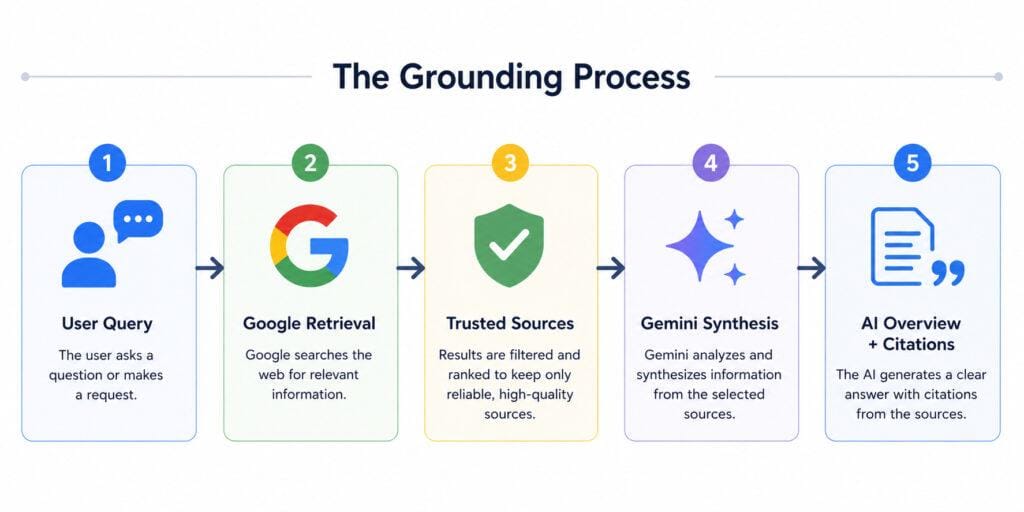
Google Grounding is the process of connecting AI-generated answers to real and verifiable web sources.
Instead of generating information entirely from memory, Google’s AI systems search the live web, extract trusted information from websites, and use those sources to build AI-generated responses.
This is one of the core systems helping Google reduce hallucinations inside AI Overviews and conversational search.
In other words:
Google’s AI still needs websites. A lot more than many people think.
Google first performs a classic search across indexed web pages.
At this stage, traditional SEO still matters:
crawlability,
indexing,
authority,
page structure,
semantic relevance,
backlinks,
freshness.
The system needs candidate pages before AI can generate anything.
Step 2: Grounding
Google extracts factual signals from selected sources.
This may include:
definitions,
statistics,
code snippets,
structured lists,
technical explanations,
local business information,
workflows,
FAQ sections.
These extracted elements become the “ground truth” used by the AI.
Step 3: Generation
Gemini reorganizes the grounded information into a readable summary.
The AI is not inventing knowledge from scratch.
It is synthesizing information already discovered across trusted sources.
Step 4: Citation
Google attaches source links to support the generated answer.
Those citations are not random.
They represent pages considered useful enough to stabilize the AI response.
That distinction matters a lot more than it may seem at first.
Because once you start noticing how AI search systems actually retrieve information, you realize that Google is not simply trying to replace websites.
It is trying to reduce unreliable information while still depending heavily on the open web.
What Google Confirmed at Google I/O 2026
During [“company”,”Google”,”American technology company”] I/O 2026, the company clarified several important points regarding AI search, grounding systems, and the future of SEO.
One of the most important signals was that Google’s AI experiences still rely heavily on live web retrieval systems to access fresh and trustworthy information.
In other words:
Google AI still depends on websites.
The company also pushed publishers toward a very different content philosophy compared to the mass-produced SEO strategies that dominated the last decade.
Instead of encouraging keyword-heavy filler pages, Google increasingly appears to prioritize:
authentic expertise,
structured information,
scenario-based content,
technical clarity,
and real-world experience.
Another important clarification concerned the growing number of “AI SEO hacks” circulating online.
Google indicated that publishers do not need complex AI-specific tricks, hidden optimization systems, or artificial files such as llms.txt to become visible inside AI-powered search experiences.
The direction seems much simpler:
Create genuinely useful content that AI systems can easily understand, verify, and extract.
That aligns almost perfectly with the broader grounding logic behind modern AI search.
One of the biggest misconceptions about AI-generated content is the idea that Google automatically penalizes anything written with AI.
That is not exactly true.
The real problem is generic content.
Google is becoming increasingly effective at identifying pages that simply repeat information already available everywhere else.
This is where many websites are starting to lose visibility.
AI Search systems increasingly prefer definition-first content structures.
Instead of long contextual introductions, GEO-optimized articles now begin with direct explanations and clearly grounded statements that AI systems can easily extract and summarize.
For example, a sentence like:
“An n8n webhook automation allows WordPress to send real-time data to external APIs automatically.”
is significantly easier for AI Search systems to quote, summarize, and ground than vague introductory paragraphs.
This is becoming especially important for Google Grounding, where AI-generated answers depend on structured, precise, and easily interpretable information coming from real websites.
The Commodity Content Problem
Let’s take a simple example.
Imagine publishing an article called:
“How to Improve SEO in WordPress.”
If the article only repeats basic advice such as:
install Rank Math,
optimize image sizes,
improve loading speed,
write meta descriptions,
use keywords naturally,
then the page becomes interchangeable with thousands of others.
Google’s AI already understands these concepts extremely well.
There is very little reason to cite your article specifically.
This type of content is slowly becoming a commodity.
And honestly, this is probably where many publishers are starting to feel the impact of AI search the most.
And commodities are vulnerable to AI summaries.
What AI Cannot Easily Replace
Now compare that with a different article.
For example:
“How I Fixed CLS Issues on a WordPress Site Without Breaking Interactive JavaScript Widgets.”
That changes everything.
Now the article potentially contains:
real screenshots,
real metrics,
debugging steps,
plugin conflicts,
cache configurations,
actual mistakes,
performance results,
implementation details.
This is no longer generic information.
It becomes experience-driven content.
And experience-driven content is exactly the type of material AI systems often need for grounding.
While working on technical SEO pages and interactive tools, I started noticing that highly specific content tends to align much more naturally with how AI retrieval systems operate compared to broad generic articles.
Why Experience Matters More Than Ever
For years, SEO discussions focused heavily on:
keywords,
backlinks,
optimization scores,
publishing frequency.
Those elements still matter.
But AI search is pushing another factor back to the center of the web:
Real experience.
Google’s E-E-A-T principles already emphasized:
Experience,
Expertise,
Authoritativeness,
Trustworthiness.
AI-generated search results amplify that logic even further.
A page containing:
original tests,
technical experiments,
local observations,
screenshots,
personal implementation,
real business cases,
has a much higher probability of becoming grounding material than a purely theoretical article.
How to Make Your Website More Grounding-Friendly
Grounding-friendly content is usually:
structured,
clear,
factual,
technically organized,
and easy for AI systems to extract.
Here are some of the most important practical optimizations.
1. Use Clear Semantic Structure
AI systems extract information faster when articles follow strong semantic organization.
That means:
logical H2 and H3 sections,
short explanatory paragraphs,
direct definitions,
bullet points,
comparison tables,
FAQ sections.
Instead of hiding information inside long blocks of text, modern SEO increasingly rewards clarity.
2. Write Definition-First Paragraphs
This has become extremely important for GEO.
Example:
Bad structure:
“Modern automation systems have evolved dramatically during the last decade and companies increasingly rely on them to simplify digital workflows…”
Better structure:
“An n8n webhook automation allows WordPress to send real-time data to external APIs automatically.”
The second format is easier:
to extract,
to summarize,
to quote,
and to ground.
3. Add Structured Data
Schema.org markup helps search engines understand page context more precisely.
For technical articles, useful schema types may include:
Article,
TechArticle,
FAQPage,
HowTo,
Organization,
Person.
JSON-LD markup acts almost like a translation layer between your content and machine interpretation systems.
4. Increase Fact Density
AI systems prefer structured information.
Pages containing:
statistics,
numbered steps,
concise explanations,
data tables,
definitions,
process breakdowns,
are easier to use for grounding than pages filled with vague filler text.
This does not mean articles should become robotic.
It means useful information should remain easy to identify.
5. Improve Technical Crawlability
Grounding also depends on retrieval speed.
If your pages:
load slowly,
break rendering,
block JavaScript,
create crawl confusion,
or generate indexing issues,
Google may struggle to use them effectively inside AI-driven search experiences.
Technical SEO still matters.
In fact, one surprising thing I noticed while reviewing recent AI search behavior is that technical clarity may actually become more important again, not less.
Probably more than people realize.
How AI Systems Already Understand Websites
One of the most interesting things I noticed while researching grounding systems was how modern AI models already reconstruct website ecosystems from scattered public signals.
To better understand this behavior, I experimented with several prompts asking AI systems to analyze my own websites and traffic strategy publicly.
The results were surprisingly nuanced.
Without access to private analytics, Search Console data, or internal business information, the AI still managed to reconstruct:
the relationship between different websites,
the likely traffic models,
niche positioning,
multilingual strategy,
technical SEO priorities,
and even possible authority limitations.
What surprised me most was not perfect accuracy.
Some assumptions were partially incorrect or speculative.
But the system still built a coherent strategic interpretation from publicly accessible web signals.
That reveals something extremely important about modern AI search:
AI systems do not simply copy websites.
They infer relationships between:
entities,
technologies,
topics,
brands,
content structures,
and public authority signals.
This is exactly why grounding and contextual SEO are becoming increasingly important.
Even smaller independent websites can contribute meaningful contextual signals when their structure, topical consistency, and technical clarity remain strong.
In many ways, this may become one of the biggest shifts in modern SEO.
Search engines are no longer just indexing pages.
They are gradually building contextual maps of digital ecosystems.
What I’m Currently Testing on Scriptobits
Since Scriptobits is still a growing independent project, it creates an interesting environment for observing AI search behavior in real time.
Rather than focusing purely on traffic volume, I’ve recently been paying much closer attention to how Google AI systems appear to retrieve and interpret structured technical content.
Some of the elements I’m currently testing include:
stronger FAQ structures,
more extractable paragraph formatting,
technical articles with higher fact density,
interactive SEO tools,
multilingual topic targeting,
and more scenario-based content instead of generic keyword pages.
One particularly interesting observation is that highly specific technical pages often appear far more aligned with AI retrieval logic than broad informational posts.
This becomes even more visible in smaller multilingual environments like Luxembourg, where fewer high-quality regional grounding sources exist.
While these are still early observations rather than definitive conclusions, the overall direction feels increasingly clear:
Structured data is also becoming increasingly important in AI Search and Google Grounding systems.
Schema.org markup helps search engines better understand the context, structure, authorship, and expertise behind a page. In many ways, JSON-LD acts as a translation layer between human-written content and machine interpretation systems.
For technical and GEO-focused articles, useful schema types may include:
Article
TechArticle
FAQPage
HowTo
Organization
Person
As AI-generated answers continue evolving, structured data helps AI systems connect information to real websites, real authors, and verifiable sources more accurately.
Why Interactive Tools Are Becoming Extremely Valuable
One fascinating consequence of AI search is that interactive tools are becoming harder to replace.
Google can summarize an article.
But summarizing utility is much more difficult.
This is why:
calculators,
generators,
dashboards,
widgets,
simulators,
interactive calendars,
SEO tools,
are becoming strategically important.
A dynamic tool keeps users engaged beyond simple information retrieval.
And that changes the relationship between SEO traffic and user behavior.
For websites monetized with AdSense, this becomes particularly interesting.
The Luxembourg Advantage in AI Search
This part is often ignored in global SEO discussions.
Most GEO conversations focus almost entirely on massive English-speaking markets.
But smaller multilingual environments can behave very differently, especially when AI systems have fewer reliable local sources available.
Smaller multilingual markets like entity[“country”,”Luxembourg”,”Luxembourg”] operate very differently from massive English-speaking ecosystems.
And in many ways, that creates opportunities.
Lower Competition for High-Quality Local Sources
Many industries in Luxembourg still have:
weak technical content,
limited GEO optimization,
inconsistent structured data,
outdated multilingual pages,
or very little educational content.
That means a well-structured local article can sometimes become disproportionately valuable.
Especially for:
finance,
logistics,
digital services,
AI implementation,
multilingual SEO,
compliance workflows,
automation systems.
Multilingual Grounding Opportunities
AI systems still have far less regional-language data compared to English.
This creates a strong opportunity for publishers producing:
French technical content,
German business content,
multilingual SEO resources,
or Luxembourg-specific digital guides.
In many cases, Google has fewer reliable regional grounding sources available.
That can significantly reduce competition.
Local Expertise Signals Matter More
As AI search becomes more contextual and personalized, regional signals gain importance.
For example:
local expertise,
regional business references,
multilingual consistency,
geographic relevance,
local case studies,
can all help strengthen topical authority.
This is particularly relevant for publishers trying to establish authority inside specialized regional niches.
What This Means for AdSense Publishers
AI search will almost certainly reduce some types of low-intent organic traffic.
That part is real.
However, another shift is happening at the same time.
Visitors arriving from AI citations are often:
more intentional,
more technically engaged,
more curious,
and more likely to continue deeper into a topic.
That creates a different traffic dynamic.
Instead of chasing massive volumes of shallow clicks, publishers may increasingly benefit from:
deeper engagement,
longer sessions,
stronger authority,
and more loyal returning readers.
For content-heavy websites monetized through AdSense, this transition could become more important than pure traffic volume alone.
The Future of SEO Is Becoming More Human
Ironically, AI search may end up rewarding some of the most human aspects of publishing.
Because AI can already generate:
generic definitions,
surface-level explanations,
recycled advice,
predictable SEO filler.
But AI still struggles to replicate:
real-world experimentation,
technical troubleshooting,
nuanced opinions,
regional expertise,
original workflows,
lived experience.
The websites most likely to survive the next evolution of search are probably not the ones producing the highest volume of content.
They are the ones producing:
the clearest,
the most useful,
the most experience-driven,
and the most technically trustworthy information.
Final Thoughts
Google’s grounding system changes the way we should think about SEO.
The goal is no longer only to rank.
It is increasingly to become a trusted source that AI systems rely on.
That means publishers should stop asking:
“How do I outwrite AI?”
And start asking:
“What information can I provide that AI cannot invent alone?”
In 2026, AI Search Still Needs Real Websites because AI systems still depend on trustworthy human-created sources.
That question may define the next generation of SEO.
FAQ
What is Google Grounding?
Google Grounding is the process of connecting AI-generated answers to real web sources in order to improve factual accuracy and reduce hallucinations.
What is GEO?
GEO stands for Generative Engine Optimization. It refers to optimizing content so that AI-powered search systems can easily understand, extract, and cite information from a website.
Does Google penalize AI-generated content?
Google does not automatically penalize content created with AI. However, low-quality, generic, or unhelpful content may lose visibility regardless of how it was produced.
Can AI Overviews reduce website traffic?
Yes, AI Overviews can reduce some zero-click informational traffic. However, highly specialized and experience-driven content may still attract qualified visitors through citations and deeper searches.
Why are interactive tools becoming important for SEO?
Interactive tools provide utility that AI summaries cannot easily replace. They also improve engagement, session duration, and user retention.
Can small websites still succeed in AI search?
Yes. Smaller websites with highly specialized expertise, strong structure, and original information may become valuable grounding sources for AI search systems.