
SEO Content Calendar 2026 : 365+ Content Ideas and the Ultimate SEO Content Planning Guide
If you have ever stared at a blank page wondering what to publish next, you are not alone. In 2026, using a SEO content calendar 2026 is no longer optional for creators who want consistent traffic and long-term growth. In 2026, content creation is no longer about inspiration, it is about planning. Search engines reward consistency, relevance and timing, while audiences expect content that connects with real moments, trends and needs. Publishing randomly is no longer a viable strategy if you want sustainable traffic.
This guide is designed to solve one specific problem: how to plan an entire year of SEO-driven content without stress, guesswork or creative burnout. By the end of this article, you will understand why successful creators plan their content months in advance, how seasonal and event-based content impacts SEO, and how you can build a complete editorial roadmap for 2026.
Why content ideas dry up in 2026 (and why a SEO content calendar 2026 fixes it)
The main reason creators struggle with content ideas is not a lack of creativity. It is a lack of structure. Most blogs and content projects start with enthusiasm, publish intensely for a few weeks, then slowly lose momentum. Ideas become repetitive, topics feel forced, and publishing turns into a chore.
In 2026, this problem is amplified by competition. Every niche is crowded, AI tools generate endless generic content, and audiences are exposed to the same recycled topics across platforms. Without a clear plan, it becomes almost impossible to stand out or stay consistent.
Why publishing randomly hurts SEO
Search engines do not rank content in isolation. They evaluate patterns. When you publish randomly, without thematic structure or seasonal logic, you send weak signals to search engines. Your content lacks topical authority, internal linking opportunities are missed, and you often publish too late to benefit from search demand peaks.
A planned editorial calendar allows you to publish content when search interest is rising, not after it has already peaked. This alone can make the difference between a page that never ranks and one that brings steady traffic month after month.
How successful creators plan content differently
High-performing blogs, niche sites and content-driven businesses do not rely on daily inspiration. They work with editorial systems. These systems are built around:
- Seasonal trends
- Recurring events
- Awareness days
- Product cycles
- Business goals such as traffic, leads or affiliate revenue
By anchoring content to real-world events and predictable moments, creators eliminate uncertainty. They know what to publish, when to publish, and why each piece of content exists.
The SEO power of seasonal and event-based content
Seasonal content is one of the most underused SEO levers. Search behavior follows calendars. People search differently in January than in July, and differently before major events, holidays or awareness days.
When your content is aligned with these moments, you benefit from higher relevance, better click-through rates and stronger engagement. Over time, this builds topical authority and improves your overall search visibility.
What a real SEO content calendar looks like
A real SEO content calendar is not a simple list of dates. It is a strategic system that connects ideas to objectives. Each content opportunity should answer three questions:
- What is the goal of this content?
- Why should it be published at this time?
- How does it fit into the broader content strategy?
Spreadsheets and static PDFs often fail because they do not evolve with your workflow. They list ideas, but they do not help you execute, track or optimize.
How to plan 365 days of content step by step
Planning a full year of content may sound overwhelming, but it becomes manageable when broken down into clear steps. A SEO content calendar 2026 transforms this process into a structured workflow instead of a creative guessing game.
Step 1: Identify key moments throughout the year
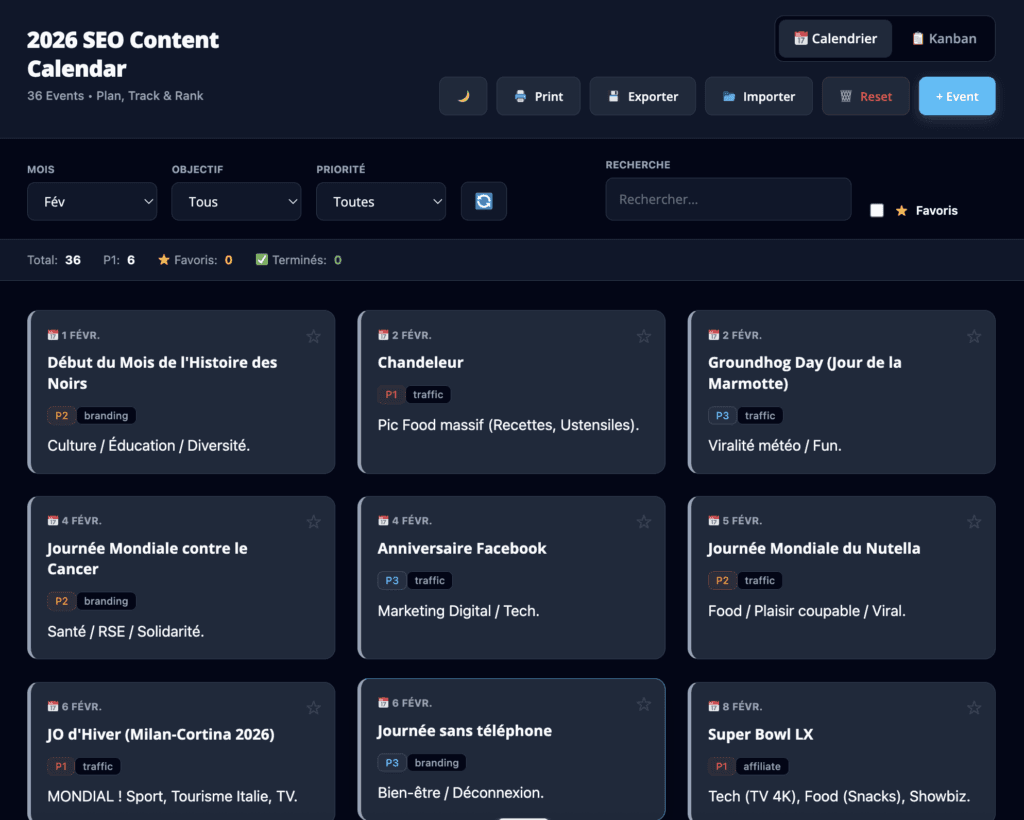
Start by mapping seasons, holidays, awareness days, industry events, and recurring trends relevant to your niche. These moments act as anchors for your content and provide natural hooks for search demand.
Step 2: Match events with search intent
Not every event deserves the same type of content. Some moments are ideal for informational articles, others for comparisons, reviews, or evergreen guides. Aligning each event with search intent is essential when building a SEO content calendar 2026.
Step 3: Define priorities and business goals
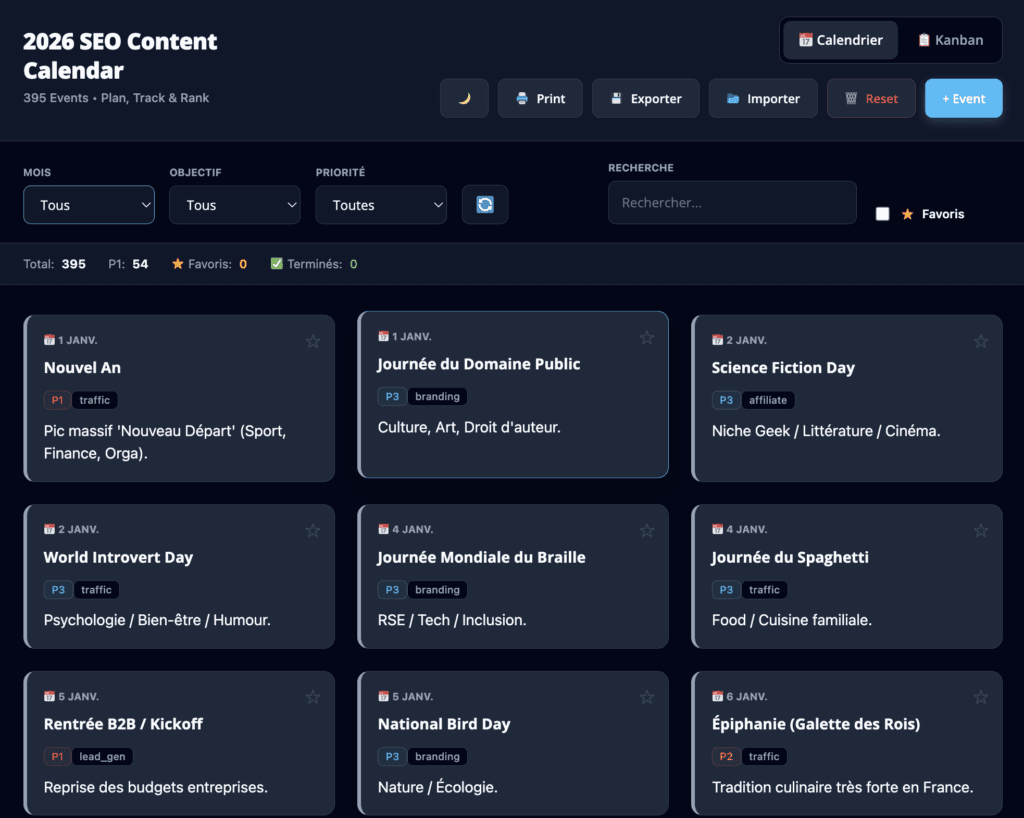
Each piece of content should have a clear objective: traffic growth, lead generation, affiliate revenue, branding, or e-commerce. Prioritization prevents wasted effort and keeps your strategy focused.
Step 4: Organize your workflow visually
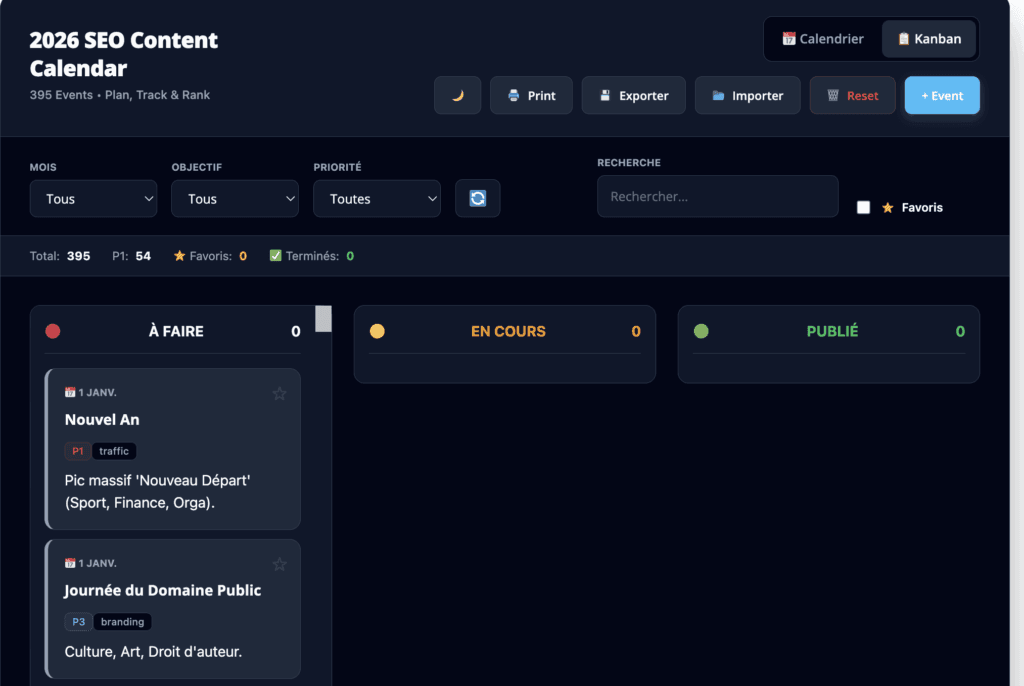
Planning is only useful if it leads to execution. Using visual workflows such as calendar and Kanban views helps track progress from idea to publication and optimization.
Step 5: Review, optimize, and adapt
A SEO content calendar 2026 is not static. Performance data, search trends, and feedback should be used to refine and adjust your plan throughout the year.
Introducing a free solution for 2026 content planning
To make this process easier, many creators use dedicated tools instead of building everything manually. One example is the 2026 SEO Content Calendar available on Scriptobits.
This free tool brings together 365+ content ideas for 2026, mapped to real-world events, seasonal trends and clear business goals. Instead of guessing what to publish, you can explore opportunities by date, niche, priority or objective, then turn them into actionable content plans.
Unlike static calendars, the tool works directly in your browser, requires no account, and allows you to organize your workflow visually using both calendar and Kanban views.
Why static PDFs fail and interactive SEO content calendars perform better
Many creators still rely on PDFs or spreadsheets to plan content. While these tools can work at a small scale, they quickly become limiting. Static documents do not adapt to changes, offer no workflow visibility, and are rarely updated once created.
Interactive systems, on the other hand, allow you to filter opportunities, track execution, and connect ideas to real business goals. This is where a SEO content calendar 2026 becomes more than a planning document, it becomes an execution engine.
By working with an interactive calendar, you reduce friction, stay flexible, and maintain momentum throughout the year.
How the SEO content calendar 2026 works in practice
Beyond theory, the real value of a SEO content calendar 2026 lies in how it is used day to day. The goal is not just to list ideas, but to transform ideas into published, optimized content.
Explore opportunities by date, goal, and priority
The calendar view allows you to browse the entire year and immediately identify high-impact moments. Each event is linked to a clear objective such as traffic, affiliation, lead generation, branding, or e-commerce. This helps you avoid publishing content without a purpose.
By filtering by month, goal, or priority, you can instantly focus on what matters most for your strategy instead of scrolling through irrelevant ideas.
Switch from planning to execution with Kanban
Once ideas are identified, execution becomes the real challenge. This is where the Kanban view comes into play. It allows you to move each content piece through clear stages: to do, in progress, and published.
This visual workflow removes ambiguity and makes it easy to see what needs attention at any time, even if you manage multiple sites or projects.
Turn events into actionable content briefs
Each event is not just a date, it comes with strategic context, suggested angles, and target keywords. This makes it easier to create focused articles, social posts, or landing pages.
For creators using AI tools, these structured inputs lead to better outputs, faster production, and more consistent quality.
Who benefits most from a structured content calendar
A structured SEO content calendar is especially useful for:
- Bloggers and niche site owners who want long-term organic traffic
- Freelancers and SEO consultants managing multiple projects
- Affiliate marketers targeting seasonal opportunities
- Content creators using AI who need better prompts and briefs
- Solo founders and small teams without complex project management tools
Real use cases for a SEO content calendar 2026
A SEO content calendar 2026 is not limited to a single type of creator. Its strength lies in its flexibility and its ability to adapt to different business models and content goals.
Bloggers and niche site owners
For bloggers, the biggest challenge is consistency. A SEO content calendar 2026 provides a clear roadmap that removes daily decision fatigue. By planning content around events and seasons, bloggers can anticipate traffic peaks, build topical authority, and maintain a steady publishing rhythm throughout the year.
This approach is especially powerful for niche sites, where timing and relevance often matter more than volume.
Affiliate marketers
Affiliate marketing relies heavily on timing. Reviews, comparisons, and buying guides perform best when published before demand peaks. With a SEO content calendar 2026, affiliate marketers can identify high-intent moments in advance and prepare content that converts when users are ready to buy.
Instead of reacting to trends too late, affiliates gain a competitive advantage by publishing early and optimizing continuously.
Freelancers and SEO consultants
Freelancers and consultants often juggle multiple clients and projects. A SEO content calendar 2026 helps standardize workflows, clarify priorities, and demonstrate strategic value to clients.
It also makes reporting easier, as every piece of content is linked to a goal and a timeline.
E-commerce and Print on Demand projects
For e-commerce and POD projects, content is closely tied to promotions, launches, and seasonal demand. A SEO content calendar 2026 helps align blog content, landing pages, and campaigns with key commercial moments.
This results in better coordination between SEO, content marketing, and revenue-generating activities.
Common mistakes to avoid when planning content
One of the most common mistakes is overplanning without execution. A calendar should simplify your work, not add friction. Another mistake is focusing only on volume instead of intent. Publishing more content does not guarantee better results if topics are poorly chosen.
Finally, many creators fail to review and adapt their plans. A good content calendar is not rigid. It evolves based on performance, feedback and new opportunities.
Frequently asked questions about SEO content calendar
s it really possible to plan an entire year of content?
Yes. When content is anchored to events, seasons, and recurring themes, planning a full year becomes realistic and efficient. A SEO content calendar 2026 provides the structure needed to make this sustainable.
How often should a SEO content calendar 2026 be updated?
Ideally, it should be reviewed monthly. While the core events remain stable, priorities and performance data can evolve. Regular reviews ensure your calendar stays aligned with your goals.
Does a content calendar improve SEO results?
Indirectly, yes. By improving consistency, relevance, internal linking, and timing, a content calendar strengthens the signals search engines use to evaluate your site.
Can a SEO content calendar 2026 work for small websites?
Absolutely. Small sites often benefit the most from planning because resources are limited. A clear roadmap helps focus effort where it has the highest impact.
Can AI tools replace content planning?
AI tools are excellent execution assistants, but without structured inputs and strategic planning, their output remains generic and difficult to scale.
Why this SEO content calendar is different
Not all planning tools are created equal. Many calendars focus only on listing dates, without explaining why a piece of content should exist or how it contributes to growth. A SEO content calendar 2026 built with strategy in mind goes further than simple scheduling.
This calendar is designed around real business objectives. Each event is connected to a clear goal such as traffic acquisition, affiliate monetization, lead generation, branding, or e-commerce. This makes every content decision intentional instead of reactive.
Another key difference is execution. Instead of forcing creators to jump between spreadsheets, documents, and project management tools, everything happens in one place. Planning, prioritization, and tracking are part of the same workflow, which reduces friction and increases consistency.
Finally, the tool is built with simplicity and privacy in mind. There is no account, no onboarding, and no hidden paywall. You can start planning immediately, keep your data locally, and export it whenever needed.
Final thoughts
In 2026, the difference between struggling creators and successful ones will not be creativity, but organization. A clear SEO content calendar turns content creation from a daily challenge into a predictable system.
If you want to stop publishing randomly and start executing with purpose, building a structured content plan is the most effective step you can take.
You can explore a free interactive 2026 SEO Content Calendar and see how a full-year content roadmap looks in practice on Scriptobits.
Why this SEO content calendar was created
The idea behind this SEO content calendar 2026 did not come from theory or trends. It came from observation. Over the years, one pattern kept repeating across blogs, niche sites, and content projects of all sizes. Most creators were not failing because they lacked skill or motivation. They were failing because they were making decisions day by day, without visibility beyond the next post.
Content planning usually started with good intentions. A spreadsheet here, a list of ideas there, sometimes a downloadable PDF calendar saved and forgotten. At first, everything seemed manageable. But as weeks passed, ideas became harder to find, priorities blurred, and content was often published too late to benefit from real search demand. The result was frustration, inconsistency, and wasted effort.
Another recurring issue was the disconnect between content and business goals. Many calendars focused only on dates or awareness days, without answering a fundamental question: why publish this content at this moment? Traffic, monetization, branding, and lead generation were treated as afterthoughts instead of being part of the planning process.
This is where the concept of a SEO content calendar 2026 started to take shape. Instead of listing events, the goal became to connect each moment to a clear objective. Instead of static documents, the focus shifted to execution. Planning had to be actionable, flexible, and directly linked to performance.
The decision was made to design a system that removes friction rather than adding complexity. No accounts, no onboarding, no locked features. Just a calendar that works directly in the browser, respects privacy, and gives creators full control over their data. A tool that helps answer three simple questions every time content is planned: what to publish, when to publish it, and why it matters.
Over time, this approach proved to be far more effective than traditional methods. Planning became lighter, execution faster, and results more predictable. The SEO content calendar 2026 was not built to replace creativity, but to protect it. By removing daily uncertainty, creators could focus on quality, strategy, and long-term growth.
If there is one idea to take away, it is this: successful content is rarely accidental. It is the result of anticipation, structure, and clear intent. A SEO content calendar 2026 exists to support that mindset and help creators move from reactive publishing to deliberate execution.
You can explore a free interactive 2026 SEO Content Calendar and see how a complete year of content planning works in practice on Scriptobits.
To build an effective content strategy, planning alone is not enough. Understanding how search engines evaluate content quality and relevance is essential. Google itself emphasizes the importance of creating helpful, people-first content designed around real user needs, not just keywords, as outlined in its official guidelines on creating helpful content.
Anticipating search demand also plays a critical role in content planning. Tools like Google Trends make it possible to identify seasonal patterns and rising interests, which reinforces the logic behind structuring content around events and predictable moments throughout the year.
This approach was validated publicly when the SEO Content Calendar 2026 was launched on Product Hunt, confirming the need for practical, execution-focused planning tools for creators and marketers.